Takeaways from Ai4 2026: As AI Demand Skyrockets, Where Do We Go from Here?


Attending an AI conference in 2026, you find out a lot about human limits—not least your own. Our team from Argos Data was excited to sponsor and exhibit at Ai4, America’s largest conference devoted to AI technology and its real-world deployment, this August in Las Vegas.
It’s a massive show with over 12,000 attendees, over 400 exhibitors and sponsors, and 1,000+ speakers, including our own Director of Innovation, Solutions & Engineering presenting on what it takes to run generative AI safely in an enterprise, across languages and markets.
We know from our own experience that this event is as timely as ever. Enterprise AI’s data and governance needs have grown right alongside the technology. The numbers are showing phenomenal growth. Worldwide spending on AI is forecast to total $2.59 trillion this year, a 47% increase year-over-year, according to Gartner. Amazon, Google, Microsoft, and Meta alone are spending roughly $725 billion combined on AI infrastructure in 2026, up 77% from what they spent last year.
This year’s expanded event offered three full days of learning, talking, and walking, followed by considerable time synthesizing what we saw and what it means for how we apply this technology. There’s a lot of enthusiasm, but there’s also a lot of uncertainty in the air over the most lingering question about AI: how do you know it works?

Laying Down the Law
Governance is the system of policies, accountability structures, and guardrails that ensure an AI system is developed, deployed, and used safely. Even though governance dominated this year’s event more than any other topic, it didn’t always get the headlines—that honor went to Geoffrey Hinton, Fei-Fei Li, and Andrew Ng, three of AI’s most recognized voices, during a spirited debate over the future of AI.
Nevertheless, everyone wanted to talk about governance, security, and compliance. Nobody we talked to needed convincing that AI requires oversight anymore. The focus now is on how to keep data secure and models under control once AI is deployed and running.
In fact, McKinsey’s 2026 AI Trust Maturity Survey found that nearly two-thirds of organizations name security and risk concerns as the top barrier to fully scaling agentic AI, and only about 30% have built the governance maturity to manage it.
While AI’s top minds were debating how to control the hype around AI, policy experts were taking a more measured look at the issue.
RegulatingAI, a nonprofit that advocates for clearer AI legislation and regulation, hosted the AI Policy Summit at Ai4 the same day as the keynote, covering regulatory frameworks, legislative requirements, and national AI strategies. The summit closed with the launch of the AI Policy 100, a public ranking of who’s shaping AI regulation.
Argos Data on Stage
On August 5, Raffaele Pascale, Director of Innovation, Solutions & Engineering at Argos Data, spoke on a panel called “Cutting-Edge Applications of Generative AI in the Enterprise,” moderated by CGTN news anchor Elaine Reyes.
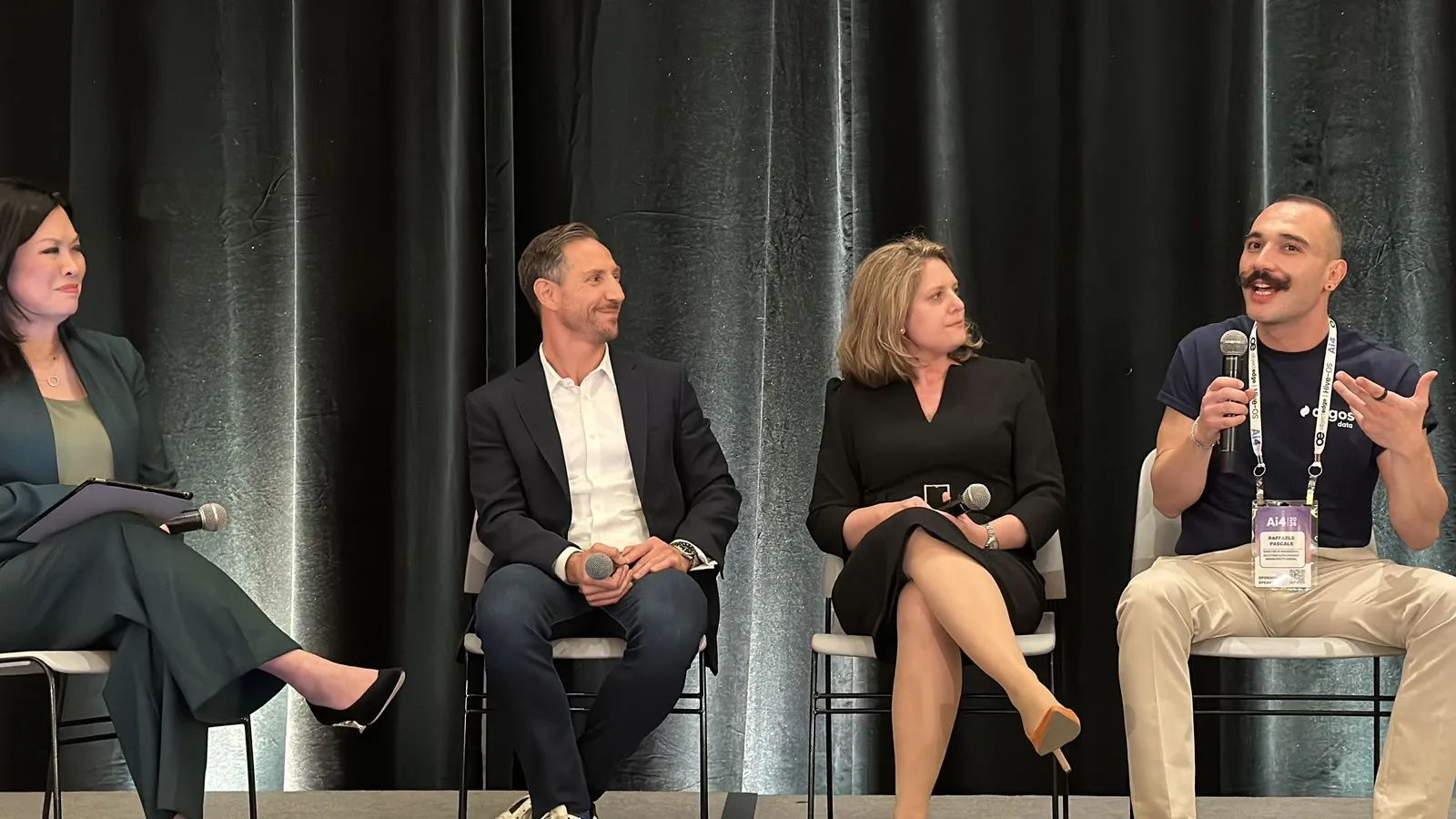
The panel also included VP of AI Solutions Semih Altinay from Phrase, which has partnered with Argos since 2023, and Home Depot’s CTO, Franziska Bell. Both companies shared their response to the big AI questions from different angles, including fixing their customers’ newly emerging pain points.
Franziska’s inside look at how a Fortune 50 company is incorporating AI gave us insights into segmentation, specifically how the company is using its virtual assistant to deliver personalized experiences for different users. Semih shared how Phrase focuses on AI fluency and employee adoption. As a result, internal deployments of AI applications are now in the triple digits.
Meanwhile, Raffaele described Argos Data’s process for internal AI adoption, and the process used to verify the quality of AI-generated work for its clients. Argos builds a rubric for each research task and routes the AI-generated output to a second, independent group of experts who review it blind, noting where reviewers disagree, as well as the scores themselves.
“It’s very easy today to generate something with AI,” Raffaele explained. “Almost nobody is able to prove if the quality is there or not.”
Humans Are More Important Than Ever
At Argos Data, we’ve always been advocates for having humans in the loop. AI is becoming more powerful all the time, but it’s human judgment that determines whether the massive amounts of data it processes and produces are trustworthy and useful.
What we heard at the show — and what we’re hearing from clients — is that companies are underestimating what it takes to deploy AI at scale. A single system can now generate more output in a day than a review team could get through in a week. Keeping pace takes purposeful and targeted investment, meaningful changes to how work gets done, and leadership willing to treat it as a priority.
Human-in-the-loop, for us, means people evaluating how a system handles intent, enforcing safety requirements, and catching bias or drift as content is prepared for different languages and markets. These checks run continuously, embedded in daily operations, rather than reviewing only once at the start. It’s how we know a system’s output can be trusted before it reaches a customer, a patient, or a regulator.

The Data-for-AI Market Is Getting Crowded
The expo floor was packed with companies offering human data, data governance, annotation, and data analytics. It’s hard to say for sure, given all the activity in this space, but it looks like new players in this market who lack a genuine value proposition are finding opportunities to be limited.
Buyers are moving away from vendors who only do generic, commodity labeling, and instead moving toward companies doing specialized, expert-level data work. Some vendors focusing on inexpensive, high-volume labeling have lost major contracts or cut staff.
The fact that so many companies are concentrating on the same problem shows us where the demand is (and where it’s not). MIT’s Project NANDA studied over 300 enterprise AI initiatives and found that 95% of enterprise GenAI pilots showed no measurable P&L impact. Many of them developed pilots using clean, curated data, then encountered production data that included years of inconsistent records nobody had reason to clean before. Meanwhile, Gartner has forecast that 60% of AI projects lacking AI-ready data will be abandoned by the end of this year.
So what does this level of AI investment mean for enterprises? We think one priority is clear: making data production-ready before launch.
Proof, Positive
Knowing if AI works when it’s deployed at scale is the multi-trillion-dollar question, but it’s not the only one. A year ago, the industry was debating whether AI needed validation at all. The critical question now is: how do you prove the validation works? Many organizations find themselves in a race with themselves, when their need to scale keeps outpacing their ability to make sure the AI is built for purpose.
It’s hard to boil an event like this one down to a single idea, but if there’s one idea ringing true right now, it’s this: confidence is not proof. When it comes to AI, sounding right and being right are two different things, and often, they are treated as the same.
When you’re working with AI, it’s important to have a partner who can help you manage its complex demands. Argos Data works with enterprise AI teams, from evaluation and governance to human review at scale across languages and markets.
Find out more at data.argosmultilingual.com.