Takeaways from the TechEx AI & Big Data Expo: Enterprise AI Grows Up


Enterprise AI is coming into its own as a practical technology. As it moves from experimentation into production, organizations are seeing what it really takes to deploy AI responsibly and at scale. The teams building and operating these systems are wrestling with data infrastructure, governance, and the complex work required to make AI perform consistently across markets. Welcome to the Wild West.
The Argos Data team was at the San Jose McEnery Convention Center for the AI & Big Data Expo, part of TechEx North America, on May 18-19, 2026. Over 8,000 attendees, 250 speakers, and 250 exhibitors across 7 co-located events talked about the changes and challenges we’re experiencing with AI, what responsible AI really means, and how to keep it safe from bad actors.
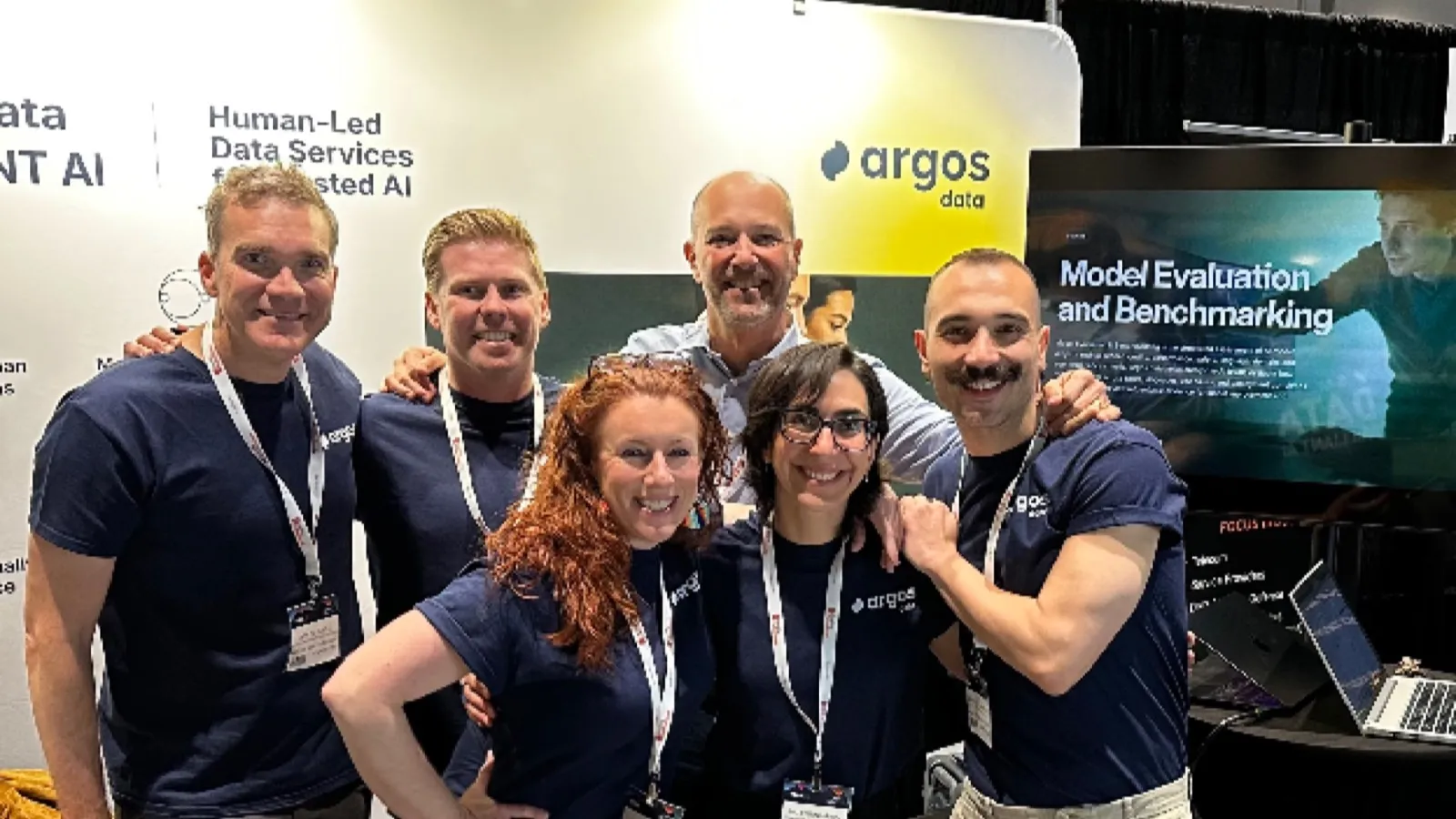
With speakers and participants from companies including Ford, JPMorgan, Walmart, Visa, IBM, and other global leaders, the event brought together teams working on real-world AI deployment across industries. We learned about generative AI, agentic systems, secure infrastructure, and explainable AI, as well as the data and language work required to make it perform across markets.
On the conference floor, the conversations split just the way you might expect. Engineering teams were focused on fragmented pipelines and annotation at scale. Enterprise buyers were focused on long-term roadmaps, ROI, and incoming compliance requirements.
Across the conference, the central question was clear: what does it really take to deploy, govern, and scale AI in production?
AI Needs Data That Works Across Systems and Markets
In our conversations with enterprise teams at the expo, the operational reality behind that question came through clearly: data is spread across multiple systems, in formats that don’t match, at a volume that internal teams can’t easily process on their own. Several described spending more time cleaning, structuring, and formatting data than using it to train or run models. The specific problem is pulling data from different sources and getting it into a consistent state across markets, languages, and internal systems that weren’t built to work together.
For organizations operating globally, the problem compounds. Data that’s difficult to standardize in one language becomes significantly harder to manage across several, especially when each region has its own formats, compliance requirements, and content workflows.
Several teams at the conference told us that language coverage has become a core requirement for everything they are building. They could manage data workflows in one language, but their users in other markets ask questions, describe problems, and express intent differently. They came to the conference looking for partners who could build and manage multilingual data at scale.

Free Agents: Keeping AI Accountable
Agentic AI was everywhere at the conference. Enterprise teams have been busy deploying autonomous systems that make decisions and trigger actions with limited human intervention, across workflows where mistakes are hard to catch and harder to reverse. The sessions focused on what governance and oversight look like in those environments, and what it takes to keep multi-agent systems performing reliably.
A recurring theme during these conversations was that human review must be part of how agentic systems operate. As autonomous AI takes on more important work, the teams running it need regular visibility into what the system is doing and why.
Validation Before Launch
Validating a model means checking whether its outputs are accurate and natural in every language it needs to serve. This requires human evaluators who understand both those languages and the subject matter. That’s not something you can build at the last minute or automate, and most teams do not have the necessary language skills in-house. Adding to the pressure, multilingual validation is often addressed late in the development cycle, when teams are already close to release and have limited time to identify, evaluate, and correct language-specific issues.
Many startups at the conference were struggling with validation. One company told us they were launching soon and multilingual validation was the problem they hadn’t yet solved. Another said quality and consistency at scale was their primary concern in the weeks before release. Neither had the internal capacity to handle it at the volume they needed, and it is becoming a more common pressure as more teams build and ship multilingual models.
Playing the Annotation Blues
Several startups had reached the point where their internal teams could no longer manage the annotation work their programs required. They started by handling it in-house, which worked when projects were smaller and more contained. As the data volume grew, maintaining consistent quality became much harder.
One company told us they could generate raw data easily but hit a wall when trying to coordinate labeling, quality checks, and annotator workflows at scale. Another said their internal workflows reached their limit as project scope expanded. Demand for annotation at volume, across languages, with stringent quality controls, is growing faster than most teams can keep up with.

Wanted: End-to-End AI Partnerships
The enterprise buyers we talked to are looking past the usual procurement checklists because they want a real, long-term partnership. They need a strong collaborator to help execute a long-term roadmap across the entire AI lifecycle.
The reason is practical. Enterprise AI programs touch data collection, annotation, multilingual validation, and quality evaluation, often simultaneously across multiple markets. Keeping that work consistent across the full AI lifecycle requires a partner who understands the full program, not just their piece of it.
Measuring AI’s Business Impact
The enterprise leaders at the AI & Big Data Expo don’t seem to be short on AI investment. What every company really wants to see is proof that the technology drives measurable business outcomes.
Let’s look at the numbers. AI investment continues to surge, but many enterprise programs are still struggling to prove measurable return. MIT found that 95% of generative AI pilots delivered zero measurable financial impact. IBM put the share of initiatives delivering expected ROI at 25%. S&P Global found that 42% of companies abandoned most of their AI projects in 2025.
Productivity gains from AI are real, but most enterprise programs are still trying to prove that the investment directly impacts the bottom line. The organizations showing a clear return right now measure success by how much time the program gives back to their employees. When a model performs reliably without constant human intervention, the return becomes visible in faster deployment, lower correction costs, and employees doing strategic work rather than troubleshooting outputs.
Surviving AI’s Wilderness Years
Given that the conference was in the heart of Silicon Valley, it’s no surprise that this year’s event was oriented towards enterprise adopters of AI, not just vendors or researchers. Companies have skin in the game now, and it’s showing.
Most of the talk at the conference focused on how to best deploy enterprise AI in daily operations, a topic that continues to evolve in real time. AI may be growing up, but that doesn’t mean it’s not going through its own awkward phase. Most companies can handle single-language AI projects on their own, but global deployment requires a different approach.
Getting through these wilderness years requires more than strong models. Argos Data works with enterprise teams on the operational side of AI, from data readiness and multilingual evaluation to annotation, validation, and quality at scale. Find out more at data.argosmultilingual.com.
Next we’ll be heading to Ai4 in Las Vegas, August 4-6, where 12,000 enterprise AI leaders will pick up this conversation. Let us know if you will be attending. We look forward to seeing you there!